
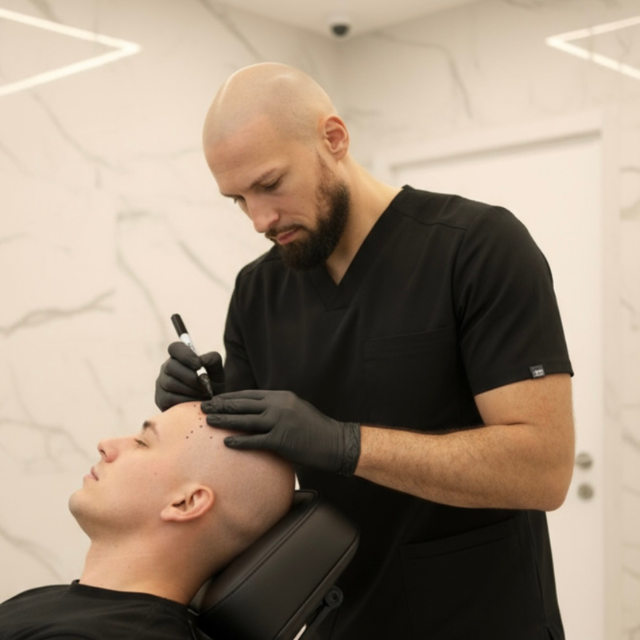
If hair loss is starting to affect your confidence, you may be considering different ways to change the way your hair looks. Two options you may come across are scalp micropigmentation (SMP) and a hair transplant.
Although both can improve the appearance of hair loss, they work in very different ways.
A hair transplant is a surgical procedure designed to move hair follicles from one part of the scalp to another. SMP is a non-surgical cosmetic treatment that uses carefully placed pigment to create the appearance of hair follicles.
So, when it comes to SMP vs hair transplant, which is right for you?
The answer depends on your hair loss, your expectations, your preferred hairstyle and whether you want to restore growing hair or change the visual appearance of your scalp.
What is the difference between SMP and a hair transplant?
A hair transplant involves taking hair follicles from a donor area and transplanting them into areas affected by hair loss.
The aim is for those transplanted follicles to continue producing hair. The procedure is therefore fundamentally different from scalp micropigmentation.
SMP does not move or grow hair.
Instead, a practitioner uses specialist equipment to place pigment into the scalp in carefully controlled impressions. These are designed to create the visual impression of individual hair follicles.
For someone who wears their hair short, SMP can create the appearance of a closely cropped head of hair. For someone with existing thinning hair, it can also be used to reduce the visual contrast between the scalp and surrounding hair.
SMP vs hair transplant: at a glance
There are several important differences to consider:
- Hair transplant: surgical procedure involving transplanted hair follicles.
- SMP: non-surgical cosmetic pigmentation treatment.
- Hair transplant: aims to restore growing hair.
- SMP: changes the visual appearance of the scalp.
- Hair transplant: requires a suitable donor area.
- SMP: does not require hair follicles to be moved.
- Hair transplant: involves surgical recovery.
- SMP: involves a healing and aftercare period but is not surgery.
- Hair transplant: results can be affected by future hair loss.
- SMP: can be refreshed with a suitable top-up as pigment gradually softens.
Neither treatment is automatically the better option. The important question is which approach matches your desired result.
Which is better for pattern baldness?
If your priority is to grow hair in areas where you have lost it, a hair transplant may be something to investigate with an appropriately qualified medical provider.
However, if you are comfortable with a closely cropped hairstyle and want a non-surgical way to change the appearance of pattern baldness, SMP may be worth considering.
SMP can recreate the visual appearance of closely cropped follicles across a bald scalp. It does not, however, create real hair growth.
The result is therefore about appearance rather than hair restoration.
What about thinning hair?
SMP is not only for people who have completely lost their hair.
For some people with thinning hair, a treatment can be designed to add the appearance of greater density. Pigment can be placed between existing follicles to reduce the contrast between the scalp and remaining hair.
This can be particularly useful when thinning is becoming noticeable under bright lighting or from above.
A hair transplant may also be an option for some people with thinning hair, depending on factors such as donor hair and medical suitability.
The two approaches therefore solve different problems.
What if you have already had a hair transplant?
SMP can also be considered after a hair transplant.
Some people seek SMP because they have visible FUE or FUT scars. Others may still have areas of low density or may be unhappy with the overall visual result of their transplant.
SMP cannot surgically repair a transplant.
However, for suitable clients, pigmentation may reduce the visual contrast of healed scars or sparse areas.
The existing hairline and graft pattern also need to be considered. A consultation is important before deciding whether SMP is appropriate.
What about the cost?
When comparing SMP vs hair transplant cost, it is important not to compare only the headline price.
Hair-transplant costs can vary depending on the clinic, procedure, number of grafts and location.
SMP costs vary according to the area being treated and the complexity of the treatment plan.
There can also be differences in recovery, ongoing maintenance and the type of result being pursued.
The most useful question is therefore not simply:
“Which one costs less?”
It is:
“Which treatment gives me the type of result I actually want?”
What is the recovery like?
A hair transplant is a surgical procedure, so there is a surgical recovery period.
SMP is non-surgical, but that does not mean the scalp requires no aftercare.
Following SMP, the skin needs time to settle and the pigment needs time to heal. Hair Savvy’s current treatment information explains that most clients have two or three sessions, spaced a few weeks apart, allowing the result to be developed gradually.
Which option looks more natural?
That depends on what you mean by “natural”.
A hair transplant can produce growing hair, while SMP creates the visual appearance of follicles.
A well-designed SMP treatment should not look like a solid block of pigment. The aim is to create controlled follicle impressions with appropriate spacing, depth and density.
Hair Savvy’s approach is to build the treatment progressively so the result can be assessed and refined rather than trying to create the final density in one appointment.
Can you combine a hair transplant and SMP?
In some circumstances, people choose to combine the two approaches.
For example, a transplant may provide growing hair while SMP is used to add the visual impression of density or camouflage suitable scars.
However, this is highly individual.
Anyone considering combining treatments should have the existing hair, scalp and previous procedures properly assessed before deciding what should be done next.
So, should you choose SMP or a hair transplant?
If your main goal is to grow hair, a hair transplant may be worth investigating.
If your main goal is to change the appearance of hair loss without surgery, SMP may be an option.
SMP can be particularly relevant for people who prefer a closely cropped hairstyle, people experiencing pattern baldness, people with thinning hair and people looking for suitable cosmetic camouflage following a hair transplant.
The best place to start is an honest assessment of your hair loss and the result you want.