
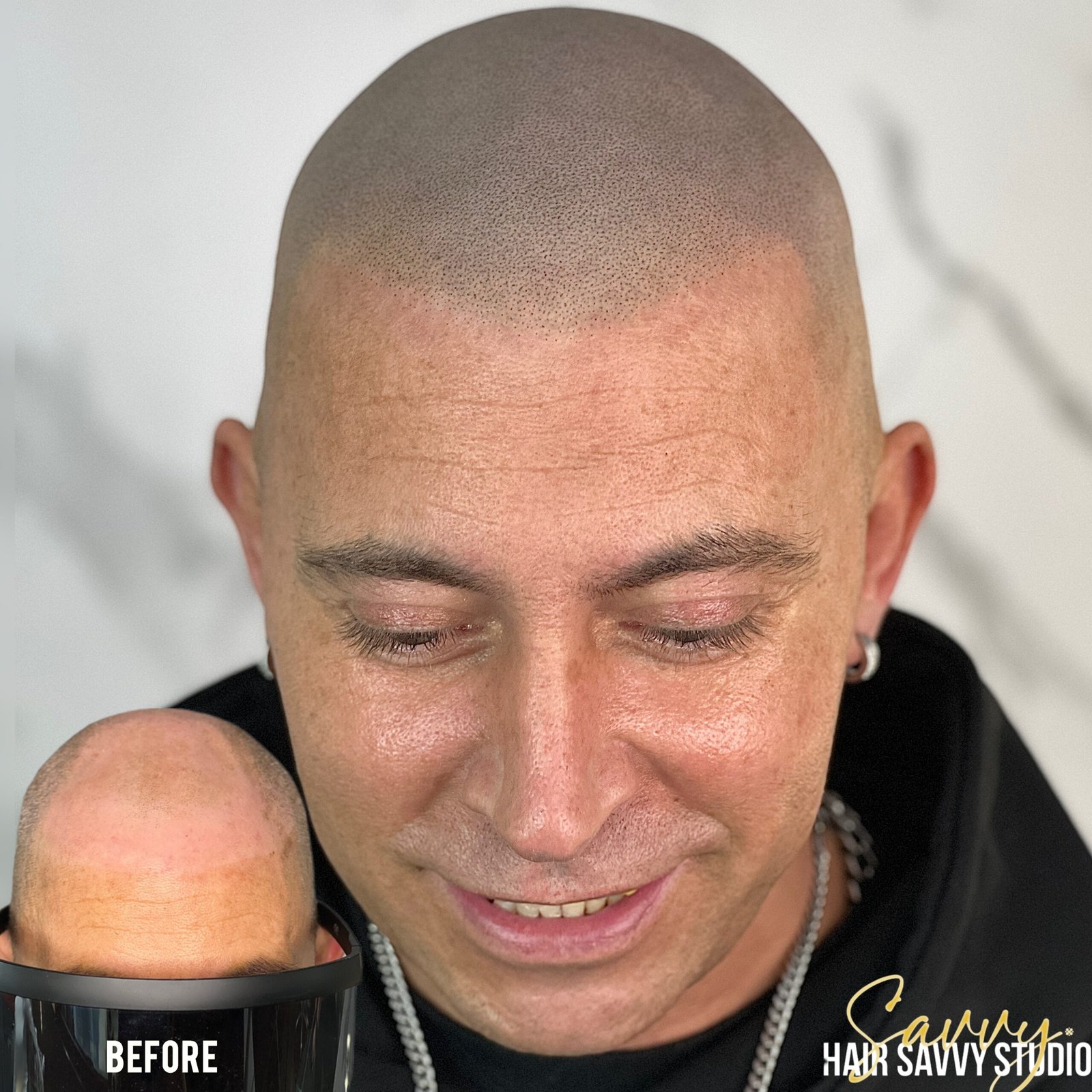
If you have been researching scalp micropigmentation, you have probably spent some time looking at SMP before and after photographs.
And it is easy to see why.
Before-and-after images can give you an idea of what is possible, but they do not tell the entire story.
The most important thing to remember is that no two SMP treatments are identical.
Your result will depend on your existing hair, degree of hair loss, skin, hairline, treatment area, preferred hairstyle and the result you are hoping to achieve.
What does an SMP before and after actually show?
An SMP before-and-after photograph shows a change in the visual appearance of the scalp.
Depending on the treatment, this might involve:
- Creating the appearance of a closely cropped head of hair.
- Reducing the appearance of visible scalp through thinning hair.
- Creating a more defined-looking hairline.
- Making patchy hair loss look more consistent.
- Camouflaging a suitable healed transplant scar.
SMP does not create new hair.
Instead, carefully placed pigment creates the visual impression of follicles.
SMP before and after for pattern baldness
For someone with extensive pattern baldness, the transformation can be particularly noticeable.
SMP can create the appearance of a closely cropped head of hair across areas where hair is no longer present.
The hairline needs to be designed carefully.
A good SMP hairline should complement the person’s face, age and preferred style rather than simply being drawn as low as possible.
The density also needs to be controlled.
The aim is to create the impression of follicles rather than a solid area of pigment.
SMP before and after for thinning hair
SMP before-and-after results can look very different when the client still has a significant amount of existing hair.
In these cases, SMP may be used as a density treatment.
Pigment can be placed between existing follicles to reduce the contrast between the scalp and the surrounding hair.
This can make thinning areas appear visually fuller without creating the appearance of a completely shaved head.
The result can be particularly useful for people who notice their scalp becoming more visible under bright lighting or in photographs.
SMP before and after for transplant scars
Scar camouflage is another type of SMP result.
People who have undergone FUE or FUT hair transplantation may still have visible marks or scarring.
The objective of SMP in these cases is not to remove the scar.
Instead, suitable healed scars can sometimes be made less visually noticeable by reducing the contrast between the scar and surrounding scalp.
FUE and FUT scars can have very different appearances, so the treatment needs to be assessed individually.
SMP before and after for alopecia
Alopecia can result in different patterns of hair loss, which means SMP results can vary significantly.
For suitable clients, SMP may help create a more consistent visual appearance across areas affected by hair loss.
For patchy hair loss, the priority may be making the scalp look more even.
For extensive hair loss, the treatment may instead focus on creating a believable closely cropped appearance.
Suitability should always be assessed individually, particularly where hair loss is changing.
What makes an SMP result look natural?
A natural-looking result depends on several elements working together.
These include:
- Hairline design
- Pigment selection
- Pigment depth
- Follicle spacing
- Density
- Existing hair
- Skin tone
- The client’s preferred hairstyle
One of the biggest mistakes is assuming that more pigment automatically means a better result.
It does not.
A result that is too dark or too dense can look artificial.
The goal is controlled replication that creates the impression of natural follicles.
Why can two SMP results look completely different?
Because every scalp is different.
Two people can have the same general type of hair loss but require completely different SMP designs.
Factors such as skin tone, existing hair, hair-loss pattern, facial structure and preferred hairstyle all influence the final result.
This is why copying somebody else’s SMP hairline is generally not the best approach.
Their hairline was designed for their face.
Yours should be designed for you.
How many sessions are needed?
SMP is generally built progressively rather than trying to create the entire finished result in one appointment.
Hair Savvy’s current treatment information states that most clients need two or three sessions, with appointments spaced a few weeks apart.
This gives the practitioner an opportunity to assess how the pigment settles and refine the density and depth.
Why can SMP look darker immediately after treatment?
Immediately following a treatment, the pigment can appear darker and more defined than the eventual healed result.
Temporary redness or tenderness can also occur.
As the scalp heals, the appearance softens and the pigment settles.
This is why judging an SMP result immediately after a session is not necessarily the same as judging the finished result.
How should you judge SMP before-and-after photos?
If you are comparing practitioners, do not just look for the most dramatic transformation.
Look for:
- Real client photographs.
- Healed results where available.
- Hair-loss patterns similar to your own.
- Natural-looking hairlines.
- Appropriate density.
- Consistent work across different clients.
- Results that look good from different angles.
You should also consider whether the practitioner explains what SMP cannot do.
Being realistic about the treatment is part of achieving a good result.
What should you realistically expect from Hair Savvy?
Hair Savvy’s stated objective is to create a result that reads as natural follicles rather than obvious dots.
The studio’s existing content focuses on individual treatment planning and progressive density, rather than applying the same design to every client.
The current results content can therefore be used alongside this article to give prospective clients both the visual examples and the context needed to understand them.
Ultimately, your own result will be individual.
The consultation is where your scalp, hair-loss pattern and desired appearance can be assessed properly.