
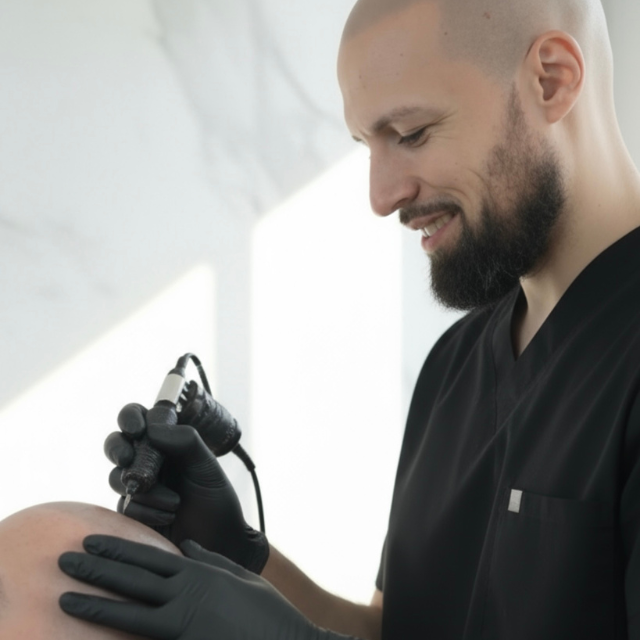
One of the biggest questions people have before booking scalp micropigmentation is:
Can SMP look natural?
It is a completely reasonable question.
After all, SMP uses pigment rather than real hair. If the treatment is poorly designed or performed, the result can look obvious.
But well-planned scalp micropigmentation is designed to create something very different: the visual impression of natural hair follicles.
The realism comes down to much more than simply choosing a pigment colour.
What makes scalp micropigmentation look natural?
Natural-looking SMP is created by bringing several elements together:
- Hairline design
- Pigment colour
- Pigment depth
- Follicle placement
- Spacing
- Density
- Existing hair
- Skin tone
- Facial structure
- The client’s preferred hairstyle
Each element matters.
The objective is not to cover the scalp with pigment.
It is to recreate the visual pattern of closely cropped follicles in a way that suits the individual.
The hairline is one of the most important parts
A hairline can make or break an SMP result.
If the hairline is too low, too straight, too dark or too sharply defined, it can immediately make the treatment look artificial.
A natural-looking SMP hairline should work with the person’s face and overall appearance.
Age also matters.
A hairline that may look appropriate on a younger person may not necessarily be suitable for an older client.
The aim should be a hairline that looks believable rather than one that attempts to recreate a teenage hairline.
Can SMP look natural on a shaved head?
Yes.
SMP is particularly well suited to a close-cropped hairstyle because the pigment creates the visual appearance of recently shaved follicles.
The scalp remains visible between the impressions.
When the density, spacing and pigment are appropriately controlled, the overall effect can resemble a closely shaved head rather than a scalp covered in ink.
This is one reason the treatment can be particularly effective for people with extensive pattern baldness.
What about SMP for thinning hair?
SMP does not have to create the appearance of a completely shaved head.
For someone who still has existing hair, a density treatment can be used to reduce the contrast between visible scalp and remaining follicles.
This can create the appearance of greater density.
The treatment needs to be particularly carefully matched in these cases because the pigment is working alongside real hair.
If the pigment is too dark or the density is excessive, the result can look less natural.
Why does poor SMP sometimes look unnatural?
There are several reasons SMP can look artificial.
These include:
- A hairline that is too low.
- A hairline that is too straight.
- Pigment that is too dark.
- Excessive density.
- Poor spacing.
- Impressions that are too uniform.
- A design that does not suit the client’s face.
- Failing to account for existing hair.
- Insufficient experience with different hair-loss patterns.
- Trying to achieve the final density too quickly.
This is why choosing an experienced practitioner is so important.
Does SMP look like dots?
This is one of the most common concerns people have.
The objective of good SMP is not to create obvious dots.
The pigment impressions are designed to replicate the appearance of follicles.
Hair follicles naturally vary in size, spacing and density, so the treatment needs to create an appropriate visual variation rather than a repetitive pattern.
Hair Savvy’s current treatment content specifically describes the goal as creating natural follicles rather than an obvious dotted effect.
Does SMP become more natural after it heals?
It can appear darker immediately after treatment than it does once healed.
The scalp may also experience temporary redness or tenderness.
As the skin heals, the pigment settles and the appearance softens.
This is another reason why SMP is normally developed over multiple sessions.
Rather than trying to achieve the final density immediately, the practitioner can assess the healed result and refine the treatment.
Hair Savvy’s current content explains that most clients need two or three sessions spaced a few weeks apart.
How realistic is SMP up close?
It is important to understand what SMP can and cannot do.
SMP does not become physical hair.
It is a cosmetic pigmentation treatment designed to create a visual illusion.
At a normal social distance, appropriately performed SMP can look like closely cropped follicles.
However, if someone examines the scalp extremely closely, they may be able to see that it has been treated.
No cosmetic treatment should be sold on the promise that nobody will ever know it has been performed.
The goal is natural-looking, not an impossible guarantee of invisibility.
Does skin tone affect how natural SMP looks?
Skin tone is one of the factors that needs to be considered when planning SMP.
Pigment colour and density should complement the individual’s scalp and existing hair.
A formula that works for one client should not simply be copied onto another.
This is another reason consultation matters.
Can SMP look natural for women?
Yes, but the design may need to be different.
Women experiencing thinning or hair loss may not want a conventional shaved-head appearance.
The priority may instead be reducing the visibility of the scalp, increasing the appearance of density or disguising areas of patchiness.
Hair Savvy’s planned female SMP service specifically recognises that women’s hair-loss concerns can require a different design approach.
This also creates a natural opportunity for the separate SMP for Women service page, where Leona can be positioned as the practitioner for female SMP treatments.
How do you choose a practitioner for natural-looking SMP?
If natural results are your priority, do not choose a practitioner based only on price.
Look at their actual work.
Ideally, review:
- Real client results.
- Healed results.
- Different hair-loss patterns.
- Different skin tones.
- Hairline work.
- Density work.
- Scar camouflage.
- Before-and-after photographs.
It is also worth asking questions during your consultation.
A good practitioner should be willing to explain what is achievable and, importantly, what is not achievable.
The Hair Savvy approach
Hair Savvy’s existing approach focuses on creating a natural-looking follicle effect rather than an obvious pigmentation result.
Treatment is personalised around the individual rather than applying one standard design to everyone.
The process is also progressive, with the pigment, density and design refined over multiple sessions where required.
Most importantly, the consultation provides an opportunity to establish whether SMP is actually appropriate.
If a particular treatment is unlikely to produce the result you want, that should be discussed before treatment begins.
So, can SMP look natural?
Yes — when it is properly planned and performed.
But natural-looking SMP does not happen simply because pigment is placed into the scalp.
The hairline, pigment, density, spacing, skin tone, existing hair and overall design all matter.
The best SMP should not be the first thing people notice when they look at you.
Instead, the aim is for the result to simply make your hair loss look less noticeable and your overall appearance more balanced.